

Community – based tourism
Community-based tourism is a type of sustainable development that requires tourism development to take place in the context of an effective partnership between the tourism sector and the local community. The infrastructure resulting from this development should serve both tourists and locals. The local community is an active participant in tourism development, with influence over planning, implementation and control. Community tourism must respect and preserve local culture, identity, traditions and heritage. Community tourism must improve the quality of life of the destination’s inhabitants. It does this by optimising their enjoyment of the economic benefits of tourism, by protecting the natural environment in which they live, while not neglecting the provision of quality experiences for visitors.
Sustainable Tourism
“Sustainable tourism is the tourism that takes full account of its current and future economic, social and environmental impacts, addressing the needs of visitors, the industry, the environment and host communities.”
World Tourism Organization – UNWTO
For many of us, the concept of sustainable tourism is rather difficult to understand or define. Indeed, what is sustainable tourism?
For us, sustainable tourism does not have to be complicated: above all, it is about maximising the positive impacts and minimising the negative impacts of the travel activities. Most importantly, sustainable tourism should place local communities and their well-being at the center of its concerns. Moreover, the preservation of their environment rather than the environment, should be a priority.
Sustainable travel experiences are co-created: on the one hand, a growing number of travelers want to make more responsible choices. On the other hand, tourism professionals committed to sustainability have a vested interest in attracting these tourists.
Community-Based Tourism
“Hospitality is the art of making people feel welcome. Our mission is to value the key role of host communities as ‘hospitality artisans’.”
The term Community-Based Tourism (CBT) describes a tourism operation that is owned, managed and coordinated by a community and contributes to its well-being while supporting sustainable livelihoods for its members, protecting its natural and cultural heritage and promoting authentic exchanges with visitors.

For Millennium Destinations, local host communities are the foundation of any travel experience. They should therefore be highlighted not only as key stakeholders but also as main right holders. We believe the principles and practices of CBT can and should be promoted to all destinations, whether they are rural or urban, emerging or developed.
Why Community-Based Tourism?
- In spite of several global crises challenges, the number of international tourist arrivals has increased steadily over the past years to reach 1.4 billion in 2018 (+6%).
- As a leading export industry and a major diver for global development, tourism is significantly contributing to the global economy.
- However, this growth has not benefited the local communities living in tourist areas:due to economic leakages, hosts receiving visitors usually get a minor portion of the revenues generated through travel and tourism activities.
- Furthermore, local host communities are the first to suffer from the negative environmental and cultural impacts of tourism that are directly affecting their well-being, identity and cultural integrity.
- Finally, many destinations have been exceeding their carrying capacities leading to thephenomenon of overtourism: it appears necessary to divert tourist flows to less visited areas.
| 71% of global tourists think travel companies should offer more sustainable travel choices | 68% of people said that it was important that the money they spent on travel went back into the local community | 78% of tourists actively seek authentic experiences that are representative of local culture |
How to develop community-based tourism – https://www.youtube.com/watch?v=YiOzuM79keQ
- Importance of the topic. (Why is it important? Value, benefits for tourism providers/customers) (5%)
Community-based tourism (CBT)’ proposes the idea of ‘tourism by the local people for the local people’. It is one of the solutions for sustainable tourism because, under this framework, local people are the key decision-makers of their tourism development and the ones to fully benefit from it. Being long-term residents of the areas, local communities are more incentivised to balance economic growth and socio-cultural and environmental impacts caused by tourism activities. At the end of the day, it is their home. However, it is crucial to clear the misconception that CBT refers to ‘village tourism,’ limited only to certain styles of tourism that take place in rural areas. CBT is a tourism management model that puts local communities at the center of the process and can encompass diverse tourism styles from rural tourism to urban tourism, nature tourism or even luxury tourism. Essentially, CBT is about community empowerment as it is a process in which local people are empowered to uplift their own livelihood.
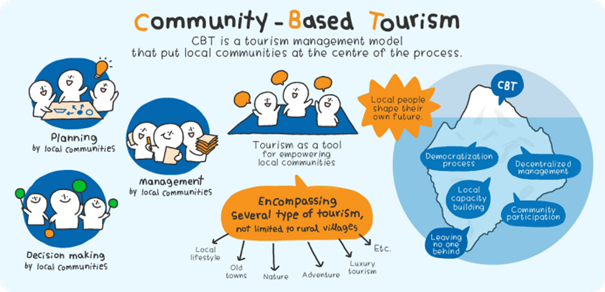
What are the benefits of community-based tourism?
The unique feature of community-based tourism is the fact that tourism experiences are hosted and managed by local communities. It is a promising niche tourism experience with lots of opportunities. More and more tourists are interested in learning about local cultures and ways to genuinely interact with local communities. Among others, the key benefits of CBT are that it:
- Sustains local culture for future generations
- Facilitates local employment
- Directly benefits locals financially
- Is fairly easy to develop with the right network
- Creates and empowers resilient and strong communities
- Adds value to your business with unique experiences
- Allows tourists to experience the diversity and customs of local cultures
- Encourages tourists to truly connect and interact with local communities
- Stimulates increased awareness and knowledge of other cultures and traditions
- Takes your business and tourists off the beaten track into rural areas
- Supports the movement of good tourism

Examples of community-based tourism experiences
- Cooking and tasting local food
- Visiting a local market
- Walk through the village
- Working on the field
- Experiencing the coffee process
- Fishing or sailing with locals
- Biking tour around the village
- Handcrafting or painting
- Storytelling by elders
- Homestay or farmstay
More information:
https://goodtourisminstitute.com/library/how-to-develop-community-based-tourism/
Community tourism is most often introduced in remote rural areas, where local communities suffer from difficult living conditions, food shortages, unemployment, poor transport links to the rest of the country and poor public infrastructure. The environment is unattractive for the development of economic activities and the relief or climatic characteristics make it unsuitable for the development of agriculture. These poor economic and social conditions have a major impact on the demographic structure of the population, with young people tending to move to areas where there are more opportunities for a better life for them. It is important to note that these areas have a competitive advantage over more developed areas, as they have many natural, social, historical and climatic features that constitute a basic invaluable asset for the development of tourism. Ways in which the local community can participate in community tourism.
- Employment in the tourism sector. Education and training of local community members for different jobs. Strong emphasis on foreign language skills, training for young people, unemployed, women. Employment as tourist guides, waiters, receptionists, animators, sales assistants, cleaners, handicraft makers and tourist office workers.
- Participation in the supply chain of tourism businesses. Local community members are most often involved as suppliers of food and handicraft products. They are involved in construction work, maintenance of tourist facilities and delivery services.
- Direct sales from the domestic market. Local suppliers sell their products directly to tourists.
- Setting up and running tourism businesses. Setting up your own business is a key aspect of empowering local community members. The state, local authorities and NGOs are important in this respect and can help to create an enabling business environment.
What are the potential negative impacts of tourism on communities?
When done thoughtfully with stakeholders in mind, tourism is hugely beneficial to communities. There are many reasons why it is important to measure the negative impacts of tourism. To better understand the importance of thoughtful community-based tourism, let’s look at some of the potential negative impacts of tourism on communities.
- Economic Leakage and Higher Prices
Tourism greatly influences communities in developing countries, especially those that take in large amounts of foreign currency. The profit generated from tourism–if not used to benefit communities–can create revenue leakage and may lead to inflation in the destination, making it hard for locals to gain or keep economic independence.
- Dependence on Tourism
Communities become economically vulnerable when tourism is their main source of income. They can become dependent on foreign visitors and have difficulty sustaining their economy during off-seasons.
- Commercialization of Traditions and Customs
Especially with regard to mass tourism, local peoples and their cultures have become marketing assets for tourism profit. Instead of preservation, local traditions and customs are commodified and used as tools to attract more tourists.
- Cultural Deterioration
Interaction between locals and visitors can cause cultural clashes, and the rapid changes caused by an influx of tourism may agitate a community’s harmony and disrupt traditional living.
- Environmental Damage
Tourism can also cause harm to the environment, leading to losses of natural resources and biodiversity, as well as general deterioration of the local biosphere as a whole.
Why is community important for sustainable tourism?
For a destination to be sustainable, tourism’s adverse economic, environmental and social impacts should be limited. Local communities are motivated to minimise negative impacts to their homes in order to continue living in them, which is why community inclusion in the tourism sector is essential for sustainability.
- A Self-sustained and Locally Managed Economy
Community-based tourism ensures locals make their own decisions and keep the money within their community. As a result, communities become self-sustainable. The funds created by tourism activities stay within the community and are used for its own good.
- Going Back to Basics: Local knowledge for preservation and sustainability
Locals know how to maintain and protect their land. They are permanent residents and they care about their environment. Locals also hold knowledge beyond what tourism professionals can provide. They know what is appropriate or not for their environment. Local involvement ensures tourism sustainability. Locals are trained to protect and sustain their environment for themselves and future touristic activities.
- Active Participation and Community Involvement
In community-based tourism, locals actively participate in the tourism decision-making process, which causes communities to gain confidence and their voice to be heard. It is important to include communities for sustainability, as community decisions have more considerable impacts than that of individuals.
- Increased Value and Protection of Local Culture
Community-based tourism is also essential for cultural preservation. The publicity of local cultures encourages locals to value and preserve their traditions and culture.


More info:
https://www.solimarinternational.com/what-is-community-based-tourism-and-why-does-it-matter/
What makes Europe an interesting market for community-based tourism?
Europe offers a big community-based tourism source market on a global level. According to IPSOS, a market research company, European tourists’ willingness to enjoy homestays is basically the same as that of tourists from the USA (27% versus 28%). Two out of three Europeans try to support local businesses and the local population. Europeans also tend to spend a lot of money: on average about €2,000 for their summer holiday. For long-haul destinations, this will be even more. Furthermore, a recent study held among tourists visiting the region of Yogyakarta in Indonesia showed they had longer stays than tourists from other parts of the world.
For European tourists, South East Asia is the main destination for community-based tourism. This mainly has to do with safety issues. In general, Asia is considered to be a lot safer than South America and Africa. However, this also means that competition in this market is a lot stronger.
We expect the CBT segment to increase slightly in the long term, by about 5% per year. However, with the coronavirus pandemic preventing the whole world from travelling, every tourism sector is seeing a serious decline in customers, including community-based tourism. More up-to-date information on how source countries are being struck by the coronavirus crisis and which policy applies in European countries can be found in the CBI’s article about the novel coronavirus for the tourism sector.
Results after introducing community tourism in destinations around the world:
Economic impacts
Improvement of the economic situation of the inhabitants due to the employment of members of the local community in tourism businesses or their own entrepreneurs. Reduction of migration from rural to urban areas.
- generates suitable and independent sources of funds for community development.
- creates employment in tourism
- increases household income
Quality of life
Improving the quality of life in the destination. Improving health care, safety, openness of people.
- Increased purchasing power of the local population
- better housing conditions
- additional employment opportunities
Education and empowerment
Through education and training, residents have been given the knowledge to participate in various areas, including tourism activities.
- Promote the acquisition of new job skills.
- Creates new professions in the village.
- Encourages use of new knowledge in the village.
- Cross – fertilization of ideas with other cultures – promotes mutual respect.
Environmental protection
Involving the local community in tourism development creates an awareness of protecting quality natural resources that contribute to the success of tourism. It is this awareness that makes people behave more sustainably and responsibly towards the environment in which they live.
- Promotes environmental responsibility.
- raises awareness of the need for conservation for tourists and villagers.
- Promotes management of waste disposal.
Preserving local culture and heritage
The development of community tourism has contributed to the promotion and thus preservation of local art, architecture, cuisine, customs, traditions, language, etc.
- Increased visibility of local attractions
- fostering respect for local culture and heritage
- strengthening the purchasing power of local representatives of local cultural heritage
Recognition and reputation
Some community tourism projects have won international awards and others have become best practices that are emulated by other destinations.
- 15 of the best community-based trips
For your next global adventure, make sure you visit and stay among local communities. You’ll not only experience your destination on a deeper level, but you may help improve lives, too…
more info: https://www.wanderlust.co.uk/content/community-based-tourism-trips/
Marketing and promotion
In most destinations where the concept of community tourism has been adopted, tourist arrivals have increased.

More info: https://www.weforum.org/agenda/2017/08/the-growth-paradox-can-tourism-ever-be-sustainable/
What is the market potential of CBT?
Community based tourism is one such tourism niche, which provides benefits to minimise negative impacts and contribute to members of the communities getting involved to protect their cultural and natural heritage and also benefit directly from the Tourism activity which is generated.
Community tourism promotes the right to information, consultation, participation and expression of opinion in areas affecting them. This type of sustainable tourism is multidisciplinary and multidimensional.